 SLAM HISTORY
ALL TIME Miami VENUES
Laver’s International Tennis Resort, Delray Beach: 1985
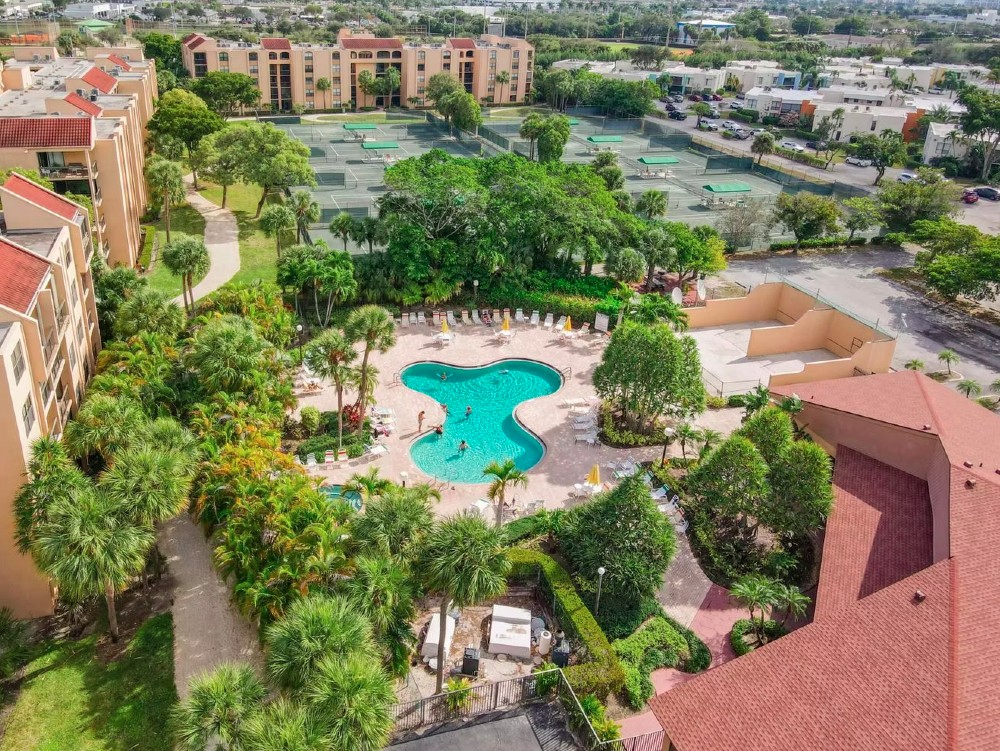
In 1985, the first tournament was held at the Laver International Tennis Resort (now the Delray Tennis Club). The complex, officially opened in 1979 by Ian Laver, a distant relative of the legendary Rod Laver, consisted of 40 courts and was built in stages. It gained its greatest popularity during the tournament. The men's and women's competitions were held simultaneously, and the first winners were Tim MAYOTTE and Martina NAVRATILOVA. Despite successfully attracting a major commercial sponsor, Lipton, and a star-studded roster of players, the tournament's financial instability, and then the tragic death of Ian Laver in a plane crash at the Dallas airport in Texas, caused further financial difficulties, which led to the move of the tournament to another location.
Boca West Resort and Club, Boca Raton: 1986
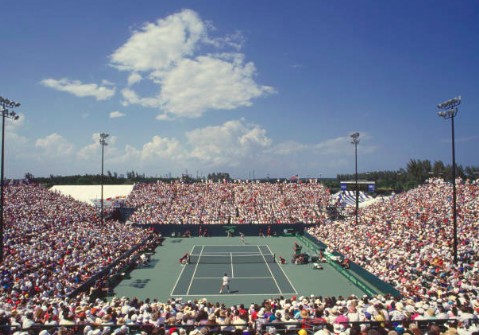
1986 was the only year the tournament was held at the Boca West Resort, now known as Boca West Country Club. The beautiful Florida scenery, the best tennis players, and the Jimmy CONNORS disqualification scandal led to the tournament's wild popularity. The number of spectators increased by 65% compared to the previous year's inaugural tournament, despite the changeable weather. Heavy tropical rains and bad weather forced a schedule change, and a downpour during the men's final interrupted play for more than 3 hours. After the tournament, the organizers realized the event needed a new, dedicated location with a large, well-equipped complex capable of hosting top players and large crowds. Boca West Country Club is now known as one of the elite residential and sports complexes of the premium class with a developed large-scale tennis infrastructure.
Crandon Park Tennis Center, Key Biscayne: 1987-2018
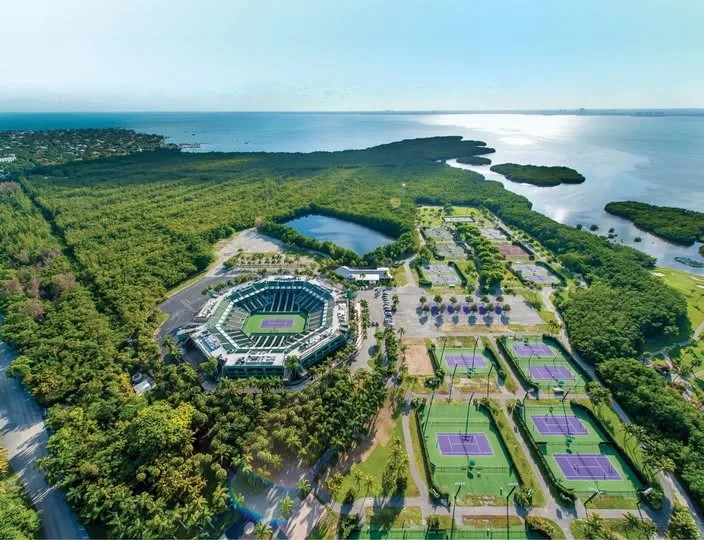
In 1987, the dream of tournament founder and driving force Butch BUCHHOLZ came true, and the tournament moved to its new permanent location, Crandon Park in Key Biscayne. He invested his own funds into the construction and convinced sponsors to do the same. Just weeks before the start, organizers hastily transformed the neglected park area into a tennis complex with 15 courts, around which temporary structures and collapsible stands were erected. It was not until 1994 that the main legendary 14,000-seat stadium was built on the complex's territory and named in honor of Butch Buchholz. Legal disputes with local conservationists, which lasted for years, prevented the organizers from expanding the tournament's capabilities, modernizing the existing infrastructure, or building new large facilities. In addition, logistical limitations were imposed by the single road to the island. All of these mounting problems could have led to the loss of the tournament and its relocation to another American location or even abroad. As a result, the organizers were forced to sign an agreement to move the tournament to Hard Rock Stadium in Miami Gardens starting in 2019.
Hard Rock Stadium, Miami Gardens: 2019-present
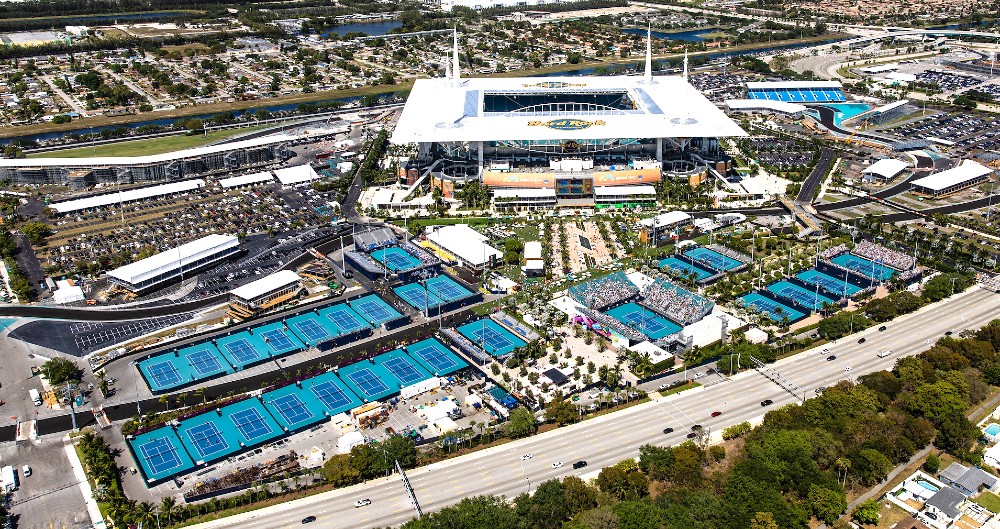
Since 2019, the home stadium of the Miami Dolphins, the local NFL team in Miami Gardens, has been the host arena for the prestigious tennis tournament. Every year, a temporary center court (Stadium Court) with a capacity of 13,800 seats is erected and dismantled after the event. Around the main stadium is a large-scale tennis campus, which also includes a separate Grandstand stadium with a capacity of 5,000 seats and 29 permanent tournament and practice courts built on former parking areas. The first year of the tournament at Hard Rock Stadium set a record attendance of 388,734. The festive atmosphere and a full range of entertainment, from culinary masterpieces from the best restaurants to art gallery exhibitions, were well received by numerous visitors.
Stadium Court at Hard Rock Stadium
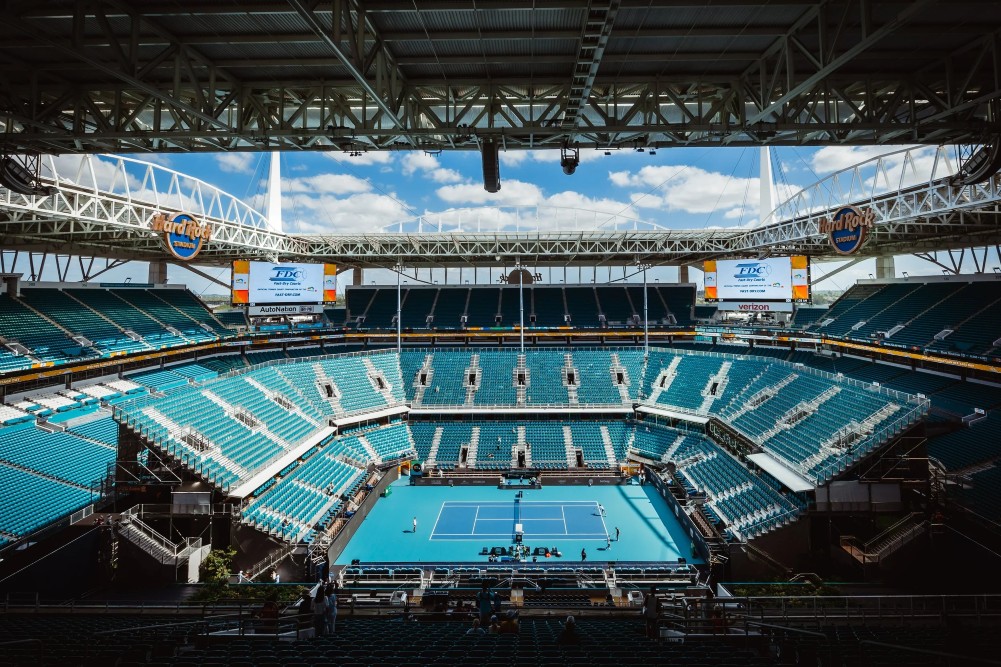
Each year, during the NFL offseason, the main arena for a tennis tournament is built directly on the football field at Hard Rock Stadium, which is why it is sometimes called "a stadium within a stadium". To create a cozy tennis atmosphere inside the large stadium, three temporary modular stands are erected. The fourth side is the permanent south stand at Hard Rock Stadium. Here are premium options for increased comfort, often including food, drinks, air-conditioned areas, and improved visibility. The north side of the football arena is not used during the tournament. The official surface of the tournament is a modern 10-layer acrylic hard court system from Laykold, with the court's signature colors: Laykold Oasis Blue for the inner court and Biscayne Blue for the outfield, symbolizing the sky and ocean of Miami.
Stadium Court Seating Map at Hard Rock Stadium
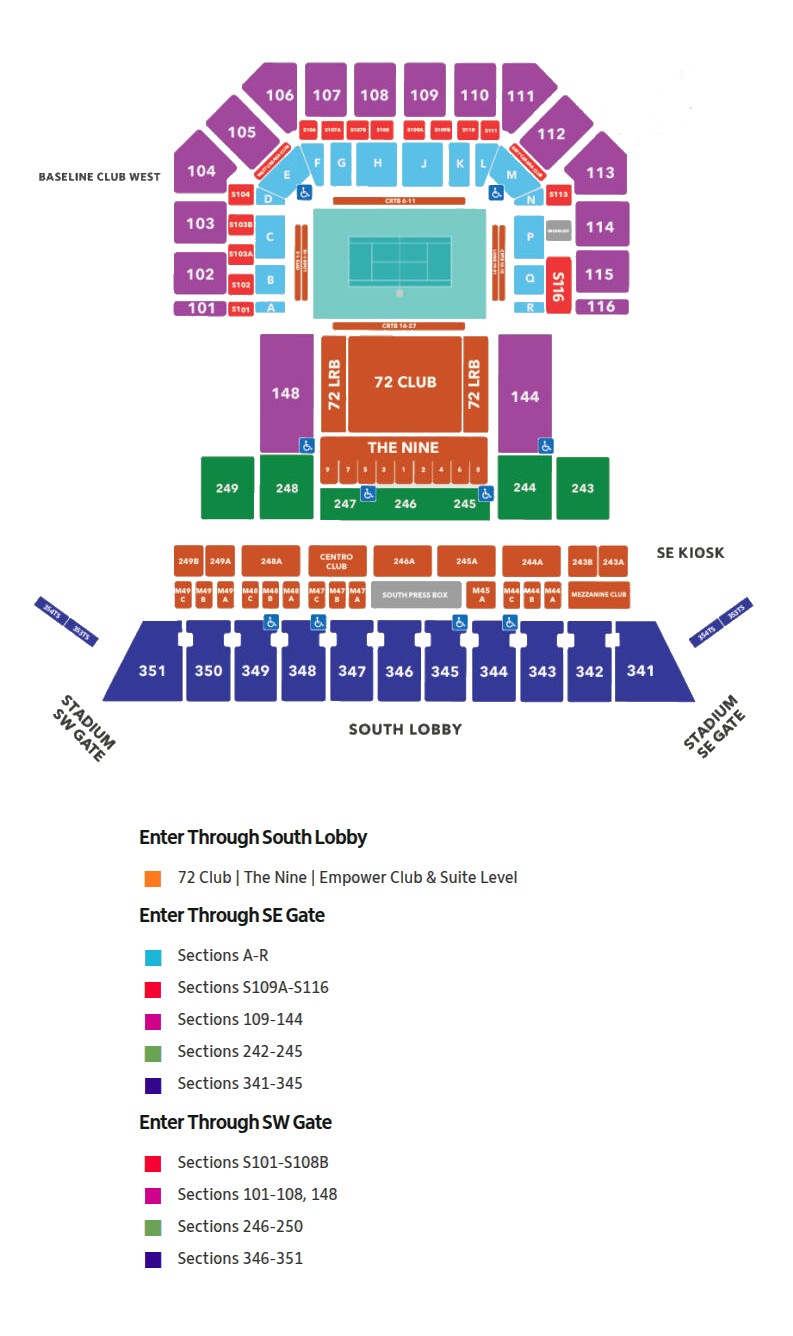
A Stadium Court ticket also gives you free access (on a first-come, first-served basis) to other courts on campus, including the second-ranked Grandstand, as well as to all other outdoor and practice courts.
Club 72 / The NINE. The most premium seats are located in the south stand. The seats themselves are located in constant shade, which is a huge advantage during daytime sessions under the scorching Miami sun. The ticket price covers unlimited premium food and drinks (including alcoholic beverages). Spectators have access to an exclusive climate-controlled lounge and a separate VIP entrance to the tournament grounds.
Courtside level. The lowest and most prestigious level of stands that surround the court on three sides (north, east and west).
- Sections A-R. The lowest and most prestigious level of stands that surround the court on three sides (north, east and west).
- Sideline Sections, start with letter S. оновлені місця на нижньому рівні, розташовані ближче до корту.
Level 100. Located directly above the Courtside areas. These stands provide the perfect balance between proximity to the players and a great viewing angle for watching the action.
Level 200. A premium area that provides a great, elevated view from the side. Tickets to this level give access to air-conditioned club areas, sun-protected seating, comfortable chairs and other premium amenities.
Level 300. This is the highest and most budget-friendly level for watching matches. This area is under the stadium's large roof, so spectators are protected from both the scorching Florida sun and possible rain.
Grandstand at Hard Rock Stadium
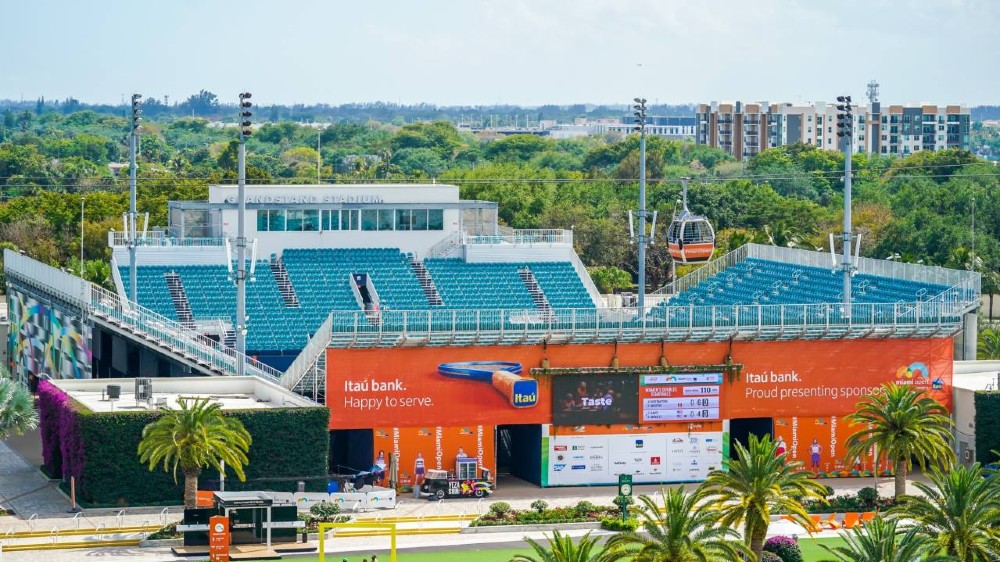
Unlike the main court, which is a temporary structure inside the soccer arena, the Grandstand is a permanent structure that opened in 2019, the tournament's first year at Hard Rock Stadium. The stadium has a capacity of 5,000. This creates the perfect balance: large enough to host tennis superstars while still providing an intimate atmosphere, with the stands as close to the players as possible. In addition to the spectator seating and boxes, the Grandstand itself features its own player facilities: locker rooms, a gym, and a recreation area. The court's exterior walls are adorned with vibrant murals that highlight Miami's cultural influence and diversity. The Grandstand is an outdoor court, so in the grueling heat and humidity of South Florida, the most popular seats are in the west and south stands, where the shadow of the stadium structures falls first during daytime sessions.
Grandstand Seating Map at Hard Rock Stadium
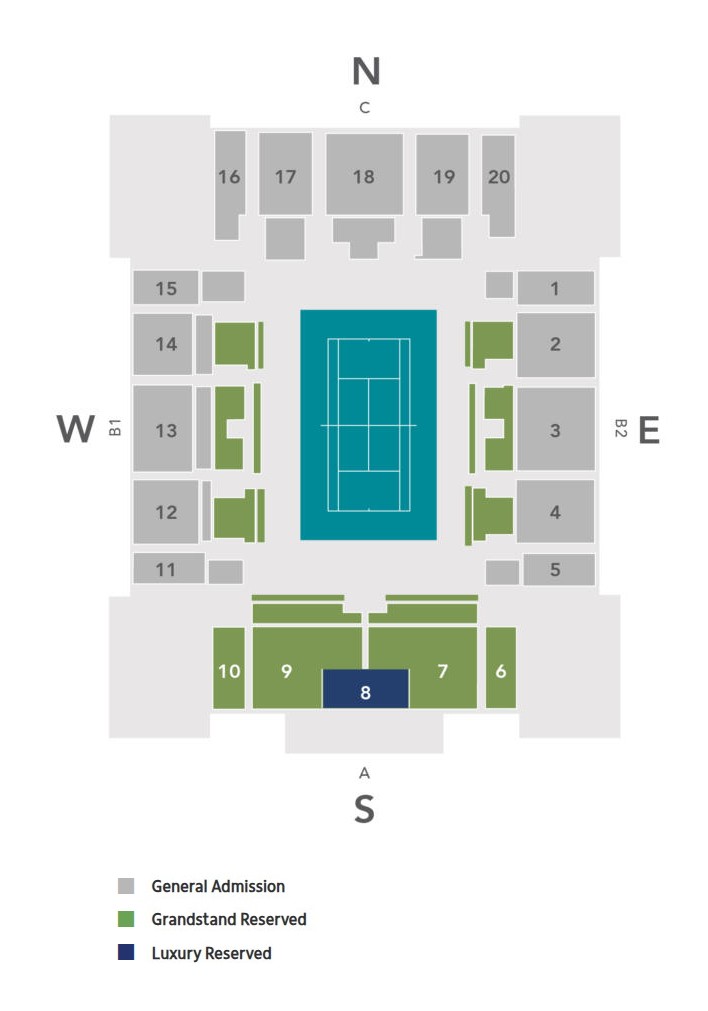
The court's southern and western stands are the first to fall into shade in the afternoon, while the northern and eastern sectors remain in the sun the longest.
General Admission. All tickets of this type operate on a first-come, first-served basis and are located strictly in rows 19 and above. General Admission seats can be accessed with a regular Ground Pass (entrance ticket to the territory) or with a ticket to the main Stadium Court. To get a good seat in the upper tier before a top match, it is highly recommended to arrive at the stands 30–45 minutes beforehand.
Grandstand Reserved. This ticket type guarantees a fixed, pre-booked seat on this court for the entire day/session. Unlike the main arena (Stadium Court), the Grandstand court is not divided into day and evening sessions. One ticket is valid for all matches of the day.
Luxury Reserved. A special premium zone, designed for Suite or Stadium Court Luxury ticket holders. In contrast to the usual reserved seats, the principle of free choice of seating (first-come, first-served) is used here.