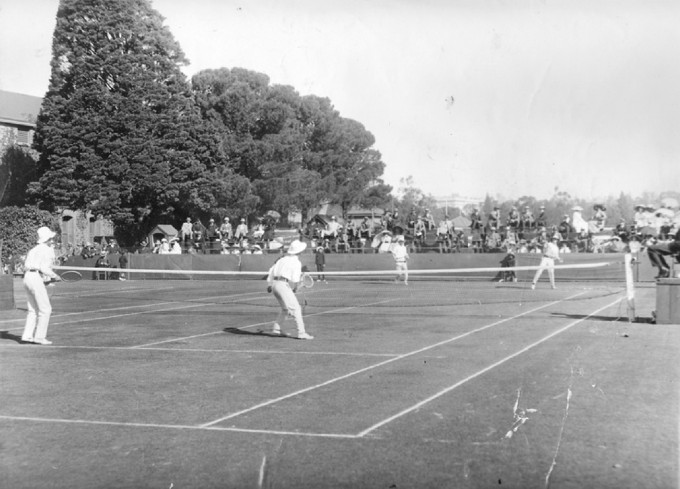
In 1905, the first Australasian Championships, later known as the Australian Open, were held at the Warehouseman's Cricket Club Ground (later known as the Albert Cricket Ground) on St Kilda Road in Melbourne, Victoria. The first competitions were held under the auspices of the Melbourne Cricket Club and later the Victorian Tennis Association. The first tennis courts for the 1905 tournament were temporarily set up directly on the cricket field. This was the classic cut grass, which was traditional for lawn tennis at the time. Despite the modest number of participants in 1905, the final match caused a stir among the locals. According to reports in The Age newspaper at the time, about 5,000 spectators watched the game.
Hagley Park in Christchurch, New Zealand: 1906
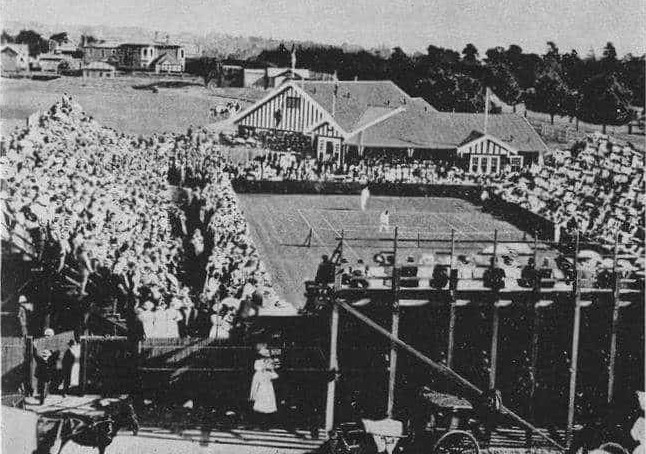
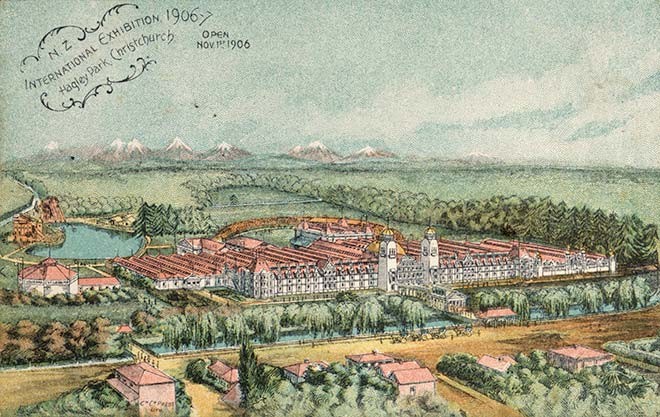
The second Australian Open was held at the United Tennis Club (now known as the Te Kura Hagley Park Tennis Club), which provided 12 courts in Christchurch, New Zealand. Due to the prevalence of clover in the grass, many players suffered embarrassing falls, sometimes several times during the match. The championships coincided with the massive New Zealand International Exhibition, which was held at Hagley Park from November 1906 to April 1907. Amusement pavilions and rides were set up directly adjacent to the North Hagley Park courts. The winner of the tournament was the local champion and favorite Anthony WILDING.
Auchenflower, Brisbane: 1907, 1915
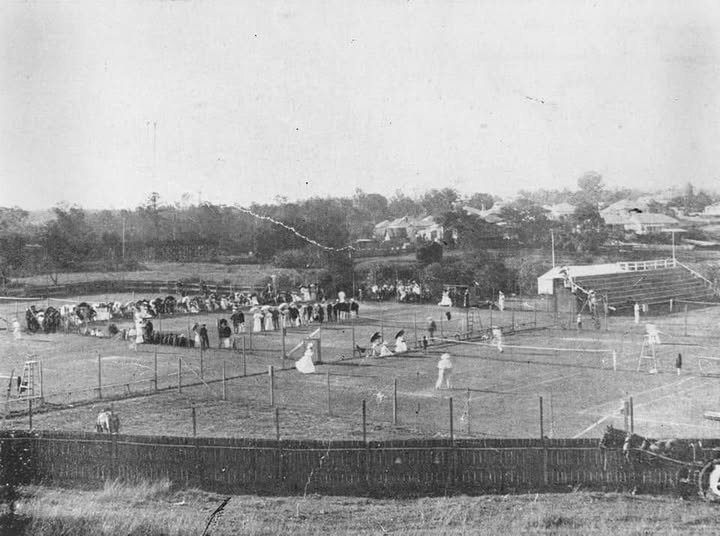
The Queensland Lawn Tennis Association courts at Auchenflower, a suburb of Brisbane, were officially opened in 1904, accompanied by rain. Three years later, in 1907, the Australian Open was held there. Heavy downpours hampered the competition, and the grass courts were wet and slippery. Despite this, tennis players liked the courts, calling them fast, flat and of high quality for their time. In 1915, the Auchenflower courts hosted the Australian Open tournament again, after which there was a three-year break due to World War I. The courts remained the main base of Queensland tennis until 1919, after which all the state's major tournaments moved to a new iconic location - Milton Courts.
Cricket Ground and Double Bay Grounds, Sydney: 1908, 1919
In 1908, the tournament was held at several locations. The preliminary rounds of the competition were held on the grass courts of the famous Sydney Cricket Ground, while the decisive matches and final were played at the Double Bay Grounds. In 1919, the competition resumed after a four-year break due to the First World War. This time, the Australasian Championships (now the Australian Open) and the International Tennis Challenge (now the Davis Cup) were held only at Double Bay Stadium, in a Sydney suburb.
Perth Zoo, Perth (tennis courts were hired out): 1909
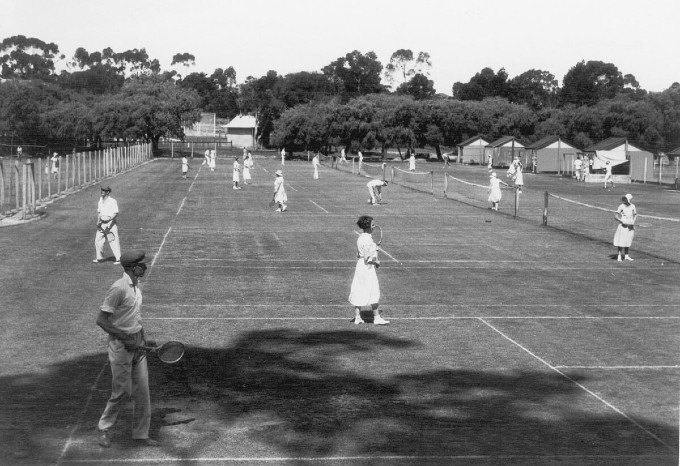
In 1909, the Zoological Gardens courts hosted the 5th Australasian Championships after South Australia withdrew from the tournament. The Perth Zoo courts were the best in Western Australia at the time. They had the added benefit of being accessible and accommodating large crowds. For this reason, the event was scheduled for a bank holiday weekend in October to maximize attendance. This tournament was the most extravagant event in Grand Slam history, with matches being played in the middle of a zoo. Today, the site of the former tennis courts is the zoo's Main Lawn, which is used as a picnic area. However, the original wooden tennis shelters, built in the early 20th century, remain.
Adelaide Oval, Adelaide: 1910, 1920
The venue was primarily used for cricket and Australian rules football, but also hosted rugby and soccer. The area around Adelaide Oval was developed in the late 1800s to accommodate the growing popularity of tennis. The arena was renowned for its visual architectural ensemble, being situated in the North Adelaide Parklands on the banks of the River Torrens, overlooking St Peter's Cathedral. However, a new complex, Memorial Drive, was later created for the purpose. A clubhouse and grandstand were built in 1923, and the north stand was constructed from the former tennis stand at Adelaide Oval, which had been dismantled and reassembled near its original site.
Hastings, New Zealand: 1912
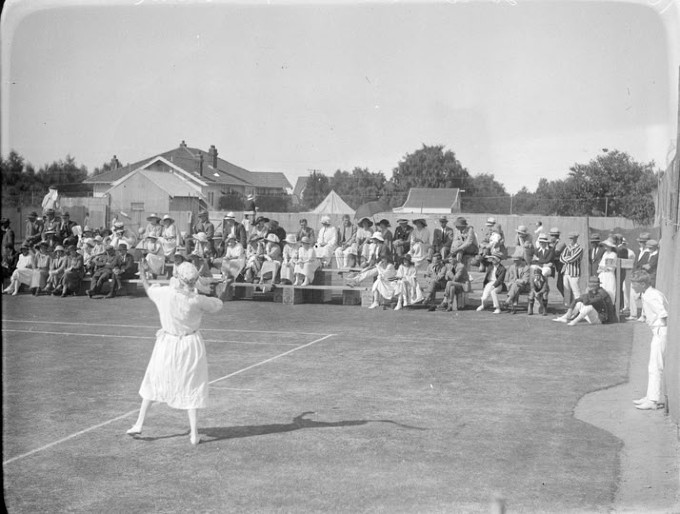
The only Australian Open tennis tournament in Hastings began in fine weather on 30 December 1912. The tournament was hosted by the Hastings Lawn Tennis Club, which had 10 grass courts. The competition was very popular, and the crowds were so large that more seats had to be hastily arranged to accommodate them. Only New Zealand and English players took part in the tournament, as the Australian tennis stars, as well as the local champion Anthony Wilding, had returned from Europe late. The finals were due to be played on 1 January 1913. However, as the New Year's Day race was being held in Hastings at that time, the matches were postponed to 2 January.
Mueller Park (Kitchener Park in 1916-1981), Perth: 1913, 1921
In 1911, the Governor of Western Australia, Sir Gerald Strickland, officially opened 12 new grass courts at Mueller Park adjacent to the historic Subiaco Oval site. At the time, the park was named after the famous German-Australian botanist Ferdinand von Mueller. In 1913, it was decided to hold the Australian Open here. However, in 1916, amid anti-German sentiment during the First World War, it was renamed Kitchener Park, after British Field Marshal Kitchener. Under this name, the venue hosted the 1921 Australian championships.
White City Stadium, Sydney: 1922, 1925, 1928, 1931, 1934, 1937, 1940, 1947, 1951, 1954, 1958, 1962, 1966, 1970, 1971
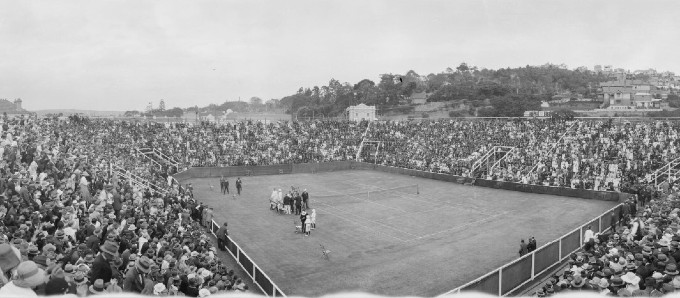
White City Stadium in Rushcutters Bay, Sydney, New South Wales, was built in 1922 for the New South Wales Championships. That same year, it hosted the Australasian Championships (now the Australian Open). The Centre Court, with a natural grass surface, seated 8,000 people, but with the use of temporary grandstands, the capacity of the main arena could be increased to as many as 25,000, as it was when the Davis Cup final was played at the venue in 1954. In 1962, Rod LAVER won the Australian Open here and began his path to his first Grand Slam. In 1970, Margaret COURT won the singles title for her third Grand Slam. From 1922 until 2000, the tennis complex was home to the NSW Open (now Mediabank International, one of the key tennis tournaments in the Australian Open Series) before the event was moved to the Sydney Olympic Park Tennis Centre at Homebush.
Milton Tennis Centre at Frew Park, Milton Road, Queensland, opened in 1915. The tennis complex consisted of four grass courts and 19 hard courts. The main arena had a capacity of 7,000 and was grass. The wooden stands held 7,000 spectators. However, during the 1958 Davis Cup Final between Australia and the United States, the capacity was artificially increased with temporary scaffolding and decking to a record 17,900. Eyewitnesses recalled that the upper tiers swayed eerily under the weight of the fans. In 1969, Rod LAVER won the Australian Open here, the first tournament to be open to professionals. It was the first of four titles that would take Laver to his second Grand Slam on the calendar. In 1999, the site was closed due to significant financial losses, and shortly thereafter, all wooden structures were dismantled.
The courts at Memorial Drive Park, Adelaide, were opened in October 1921, after the South Australian Lawn Tennis Association leased about six acres of ground, Park 22, in the South Park Lands between Goodwood and the Bay Roads for 21 years. The main arena, with a grass surface (now the main court has a hard surface), seated 6,000 people and is located in Adelaide's parkland, along the scenic War Memorial Drive, which separates the complex from the Torrens River. In 1938, Donald BUDGE took the first step toward the first Grand Slam in tennis history. Since 2009, the World Tennis Challenge (an exhibition tournament held in the week before the Australian Open) has been played at Memorial Drive.
In 1927, Kooyong Stadium at the Kooyong Lawn Tennis Club in Melbourne was opened and hosted the Australian Open. The tennis complex consisted of twenty grass courts. The main arena (now a hard-court surface) has a capacity of 8,500. In 1953, Maureen CONNOLLY won the Australian Open and stepped to the first woman's calendar Grand Slam. From 1972 until 1987, Kooyong became the permanent home of the Australian Open, for the first time in tournament history. The courts at the Kuyong were the last to host the Australian Open on grass in 1987. The winners of that historic tournament were Stefan EDBERG and Hana MANDLIKOVA. Since 1988, each January before the Australian Open, Kooyong has held the AAMI Classic, a singles-only tennis exhibition tournament. To this day, Kuyong strictly maintains the atmosphere of a classic "old-school" tennis club, where gentlemanly behavior and the traditional white uniform for players are valued.
Melbourne Park (Flinders Park in 1988-1996), Melbourne: 1988 - present
In 1988, the Australian Open moved to the new National Tennis Center at Flinders Park in Melbourne (renamed Melbourne Park in 1996) because Kooyong, the previous venue, had become too small. This year was lucky for Steffi GRAF, who won the last singles Grand Slam in tennis history. Now, the tennis complex consists of Rod Laver Arena (formerly Center Court), John Cain Arena (formerly Hisense Arena), three show courts, including Margaret Court Arena, indoor tennis practice courts, and 19 outdoor tennis courts with lighting.
Melbourne Park Grounds Map
Rod Laver Arena
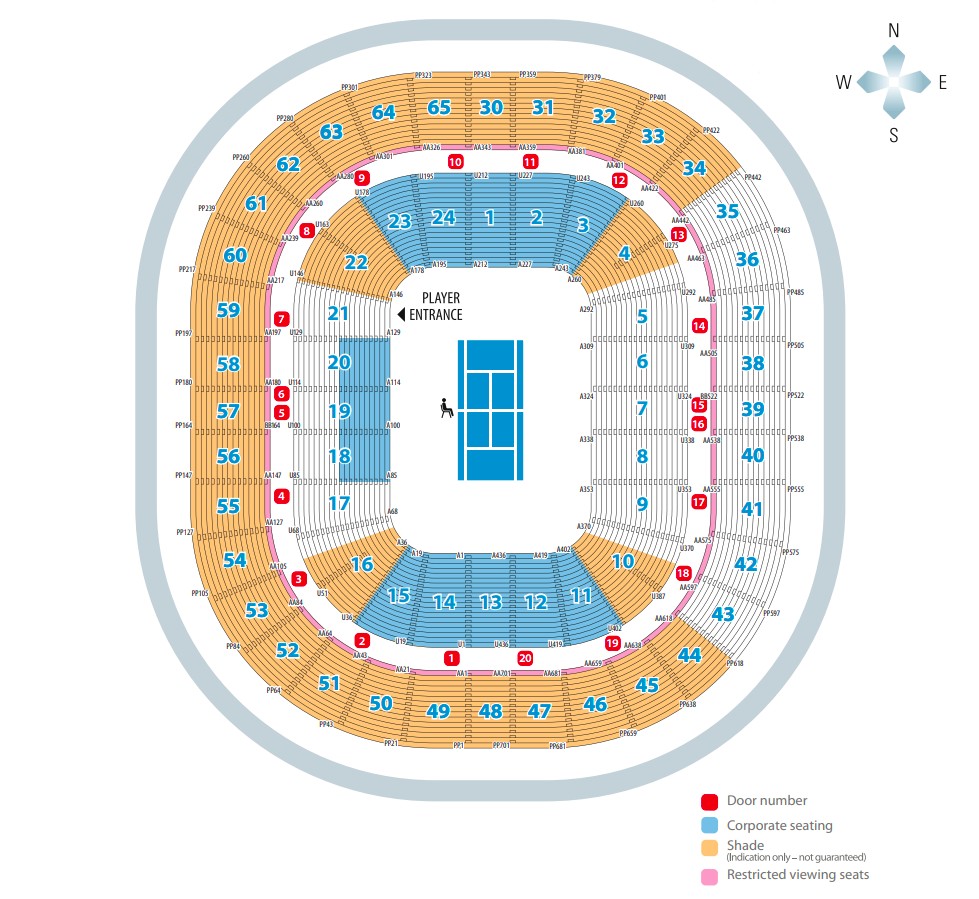
Rod Laver Arena is the main tennis stadium at Melbourne Park with a seating capacity of 14,820. In January 2000, the stadium, formerly known simply as Center Court, was renamed in honor of Rod Laver, a two-time winner of the calendar Grand Slam. From 1988 until 2007, the official surface of the Australian Open was green Rebound Ace, a tennis hardcourt composed of polyurethane rubber, fiberglass, and other materials, laid on an asphalt or reinforced concrete base. In 2008, organizers changed the surface to Plexicushion in bright blue color. The Arena features a movable roof allowing players to continue playing during rain or extreme heat.
Rod Laver Arena Seating Map
Sections 1 to 24 (lower tier) are the places closest to the court to provide the best view of the court.
Sections 1-3, 23, 24 (North) and 11-15 (South) are located directly behind the baseline and the players, making them the best choice for true tennis fans and offering a player's-eye view of the court.
Sections 4-10 and 16-22 show a side view of the court.
Sections from 25 to 65 (upper tier) provide an elevated, panoramic view of the court, allowing you to follow the ball easily. While farther from the lower tier, these seats offer a better overall view of the court.
John Cain Arena
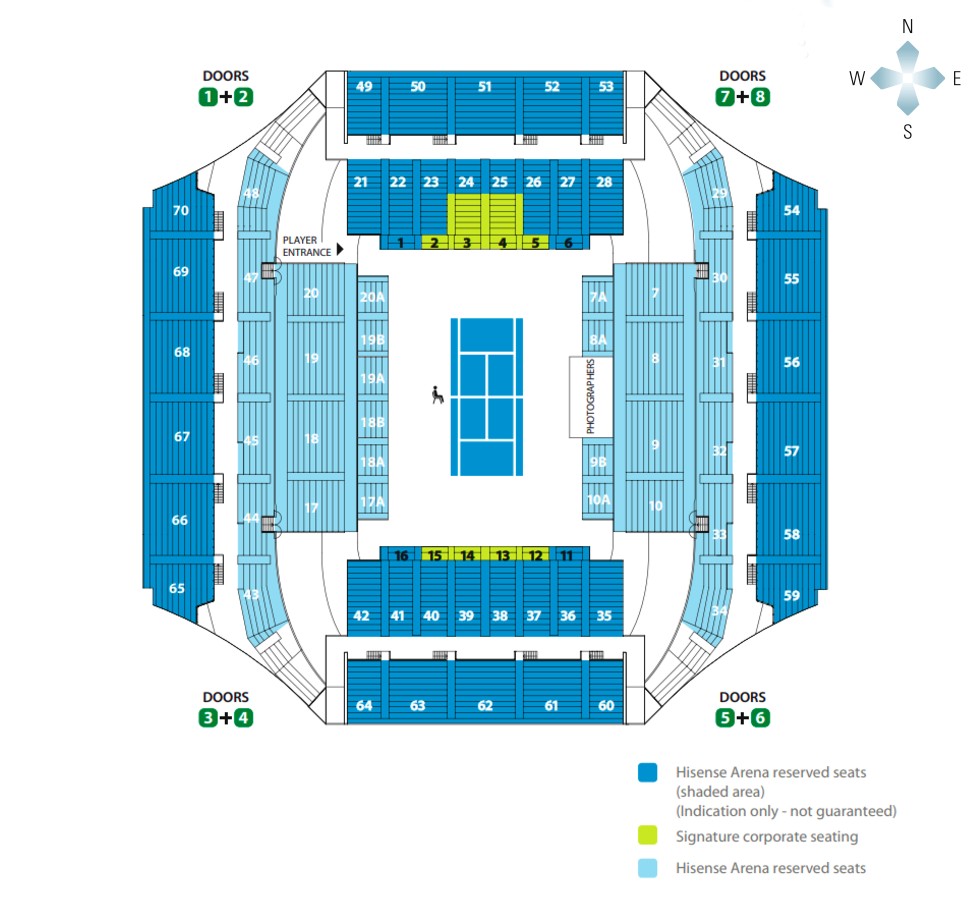
John Cain Arena was completed and opened in 2000. It was originally called the Multi-Purpose Venue, then Vodafone Arena, after the naming rights were sold to Vodafone, and in 2008, the stadium was renamed Hisense Arena after a multi-million-dollar, six-year deal. The venue has a fixed seating capacity of 4,500, with raiseable, retractable and removable seating that increases the arena capacity to 10,500. The court features a Plexicushion surface and a retractable roof, enabling all-weather play during tournament competition. In December 2020, the arena was renamed "John Cain Arena" in honor of the late State Premier of Victoria.
John Cain Arena Seating Map
Lower-tier sections (1-34) provide you with a closer look at the action.
The upper sections offer panoramic views of the court, allowing spectators to control the game fully.
Sections 17-20 and 43-48 offer consistent shade in the afternoon. West sideline seats (usually on the right side) get shaded later in the day, while the east side gets afternoon sun.
With a Ground Pass, you can access unreserved seating at John Cain Arena, generally in the upper tiers.
 SLAM HISTORY